
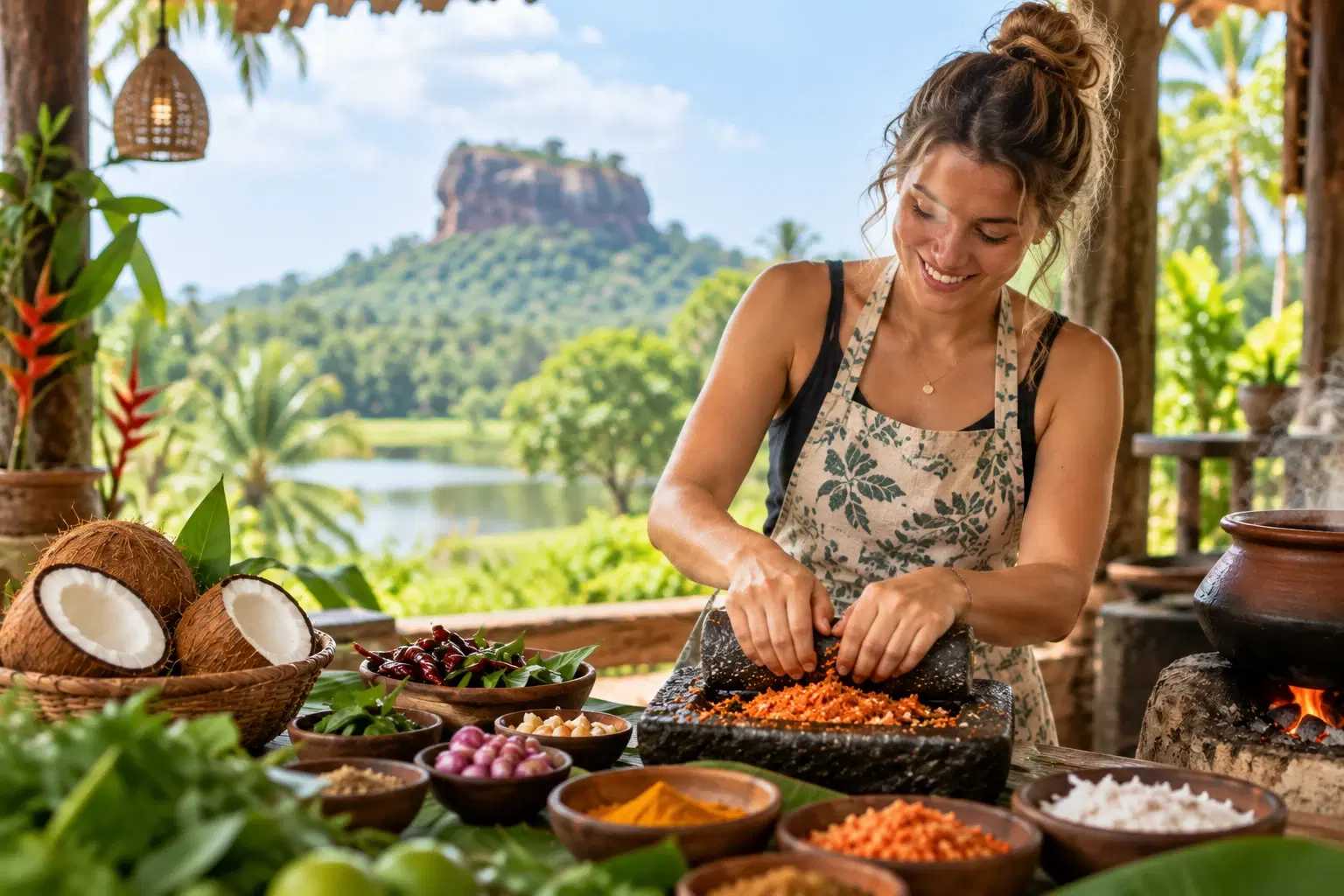
Sri Lankan food is the thing visitors most consistently underestimate before arriving and most consistently rave about afterwards. It is not Indian food with different branding. It is its own cuisine, built on coconut in three forms, a distinctive spice register, sour notes from goraka and tamarind, and a meal structure that puts five to a dozen separate dishes on the table at once.
A cooking class is the fastest way to understand it, and it is one of the best-value experiences available here. Three or four hours gets you a market walk, a kitchen full of unfamiliar technique, a meal you made yourself, and usually a recipe sheet you will actually use at home. It also works on a rainy afternoon, which in a country with as much rain as this one is a practical advantage rather than a footnote.
But the experiences on offer vary enormously in what they actually deliver, and the word 'class' covers everything from a genuine hands-on session in a family kitchen to a chef demonstrating in front of you at a hotel while you drink a welcome juice.
There is also a specific piece of knowledge that belongs at the front of any article about Sri Lankan food, because it affects a large number of travellers and almost nobody volunteers it. Maldive fish — umbalakada, dried and cured tuna — is used as a background savoury seasoning across the cuisine. It goes into pol sambol, the coconut relish that accompanies almost every meal. It goes into seeni sambol, into kiri hodi, into a good number of vegetable curries. Once mixed in it is entirely invisible. A vegetarian traveller can eat it for two weeks without knowing.
And there is a related experience that gets sold as food tourism and is not: the roadside spice gardens along the Kandy to Matale to Dambulla corridor, which a large number of drivers will suggest, and which are retail operations with a botanical preamble.
This guide covers what a good class teaches, how to choose one, the ingredient knowledge that makes eating here easier, how the regional cuisines differ, and which food experiences are worth your money.
Кратко
- A good class is hands-on: you scrape coconut, extract milk, grind spices and cook six to ten dishes
- A weak class is a demonstration you watch, often at a hotel, with little technique transferred
- Market visits genuinely add value and are worth paying more for
- Maldive fish appears invisibly in pol sambol, seeni sambol, kiri hodi and many vegetable curries
- The phrase to learn is umbalakada epa — no dried fish
- Rice and curry is a template rather than a recipe; the combination changes daily with what is fresh
- Sri Lanka is excellent for vegetarians and slightly harder for strict vegans, for one specific reason
- The roadside spice gardens on the Kandy to Matale to Dambulla corridor are retail operations, not cooking experiences
- Drivers commonly receive commission for delivering you to those gardens
- Regional cuisines differ substantially — Jaffna, the coast, the hill country and the Burgher and Malay traditions are not interchangeable