LankaTrip 见解

26 分钟阅读

How to Explore Buddhism on a Sri Lanka Holiday in 2026 and 2027: Temples, Poya Days, Pilgrim Sites and the Etiquette That Actually Matters

Vesak 2027 falls on 19 May, according to the government's holiday gazette for 2027 published in June 2026. That date also closes the next Adam's Peak season. Here is how to build a Sri Lanka trip around Buddhism as it is actually lived — respectfully, and with the right dates.

返回博客
How to Explore Buddhism on a Sri Lanka Holiday in 2026 and 2027: Temples, Poya Days, Pilgrim Sites and the Etiquette That Actually Matters

Many travellers come to Sri Lanka for its temples, and leave having seen a lot of them without quite understanding what they were looking at. That is a shame, because Sri Lanka offers something rarer than beautiful ruins: one of the oldest continuous Buddhist cultures in the world, still practised every day by the people you meet.

Theravada Buddhism has been central to life on the island since, according to tradition, the monk Mahinda brought it here in the third century BCE. Around 70 per cent of Sri Lankans are Buddhist, and the constitution gives Buddhism the foremost place. You will see it in white-clad families walking to the temple on full moon days, in the lanterns of Vesak, in the Bodhi trees on every village junction, and in the way people behave around a Buddha image.

That living quality is exactly why it rewards some preparation. A visitor who understands what a Poya day is, why the Bodhi tree matters, how to walk around a stupa and what not to do in front of a Buddha statue will have a completely different experience from one who treats temples as backdrops. And a small number of visitors each year discover, often unpleasantly, that Sri Lankans take respect for Buddhist images very seriously indeed.

This guide is written for travellers of any faith or none. It covers how to behave at temples, what the law and the courts have actually said about Buddha images and tattoos, the full moon calendar with the gazetted 2027 dates, the major festivals and pilgrimage sites, how to take part in offerings and meditation without overstepping, and how to put it all into an itinerary.

On dates: Poya days follow the lunar calendar, and Sri Lanka's public holidays are fixed by government gazette. The 2027 list was published in Gazette Extraordinary No. 2493/05 dated 16 June 2026. We have used dates reported from that gazette and say clearly where we could only confirm them second-hand.

快速摘要

  • Buddhism in Sri Lanka is a living religion, practised daily by most of the population — visit temples as a guest at a place of worship
  • Cover shoulders and knees, remove shoes and hats, and never pose with your back to a Buddha image
  • There is no law banning Buddha tattoos, and the Supreme Court ruled a 2014 arrest over one unlawful — but cover them anyway
  • Every full moon is a Poya holiday; remaining 2026 Poya days are 25 October, 24 November and 23 December
  • Vesak 2027 falls on 19 May, with 20 May also a holiday, according to the 2027 holiday gazette as reported in July 2026
  • Poson, commemorating the arrival of Buddhism, draws huge crowds to Mihintale and Anuradhapura
  • The 2026-27 Adam's Peak pilgrimage season runs from Unduvap Poya on 23 December 2026 to Vesak on 19 May 2027
  • The Temple of the Tooth charges foreign visitors LKR 3,000, or LKR 2,500 for SAARC, Thai and Myanmar nationals
  • You can take part respectfully — offering flowers, lighting a lamp, joining a Bodhi puja — without pretending to be a Buddhist
  • Do not buy antiques, and think twice before buying a Buddha head as home décor

Understanding What You Are Visiting

Sri Lankan Buddhism is Theravada, the school that also predominates in Thailand, Myanmar, Cambodia and Laos. It centres on the teachings of the Buddha as preserved in the Pali canon, which was first written down in Sri Lanka at Aluvihare near Matale. Monks, the Sangha, hold a respected place in society and depend on lay support.

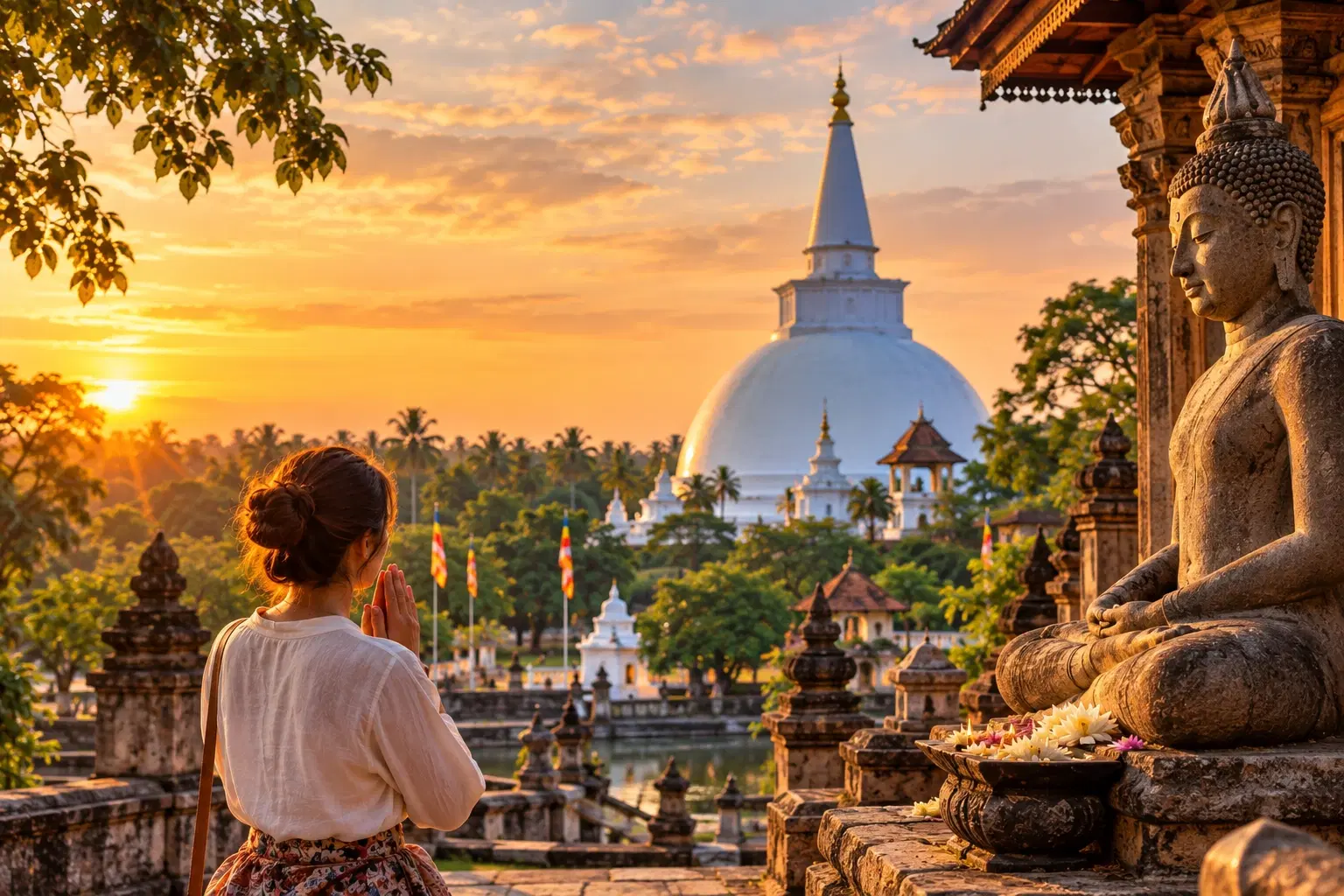
Most temples you visit will have the same key elements. The stupa, called a dagoba or chaitya, is a dome enshrining relics. The Bodhi tree, a sacred fig, descends symbolically from the tree under which the Buddha attained enlightenment. The image house contains Buddha statues and often murals. Many temples also have a devale, a shrine to guardian deities such as Vishnu or Kataragama, reflecting the way popular Sri Lankan Buddhism has long accommodated the gods.

Temples are community centres as much as shrines. On any given evening you may see children at Sunday school, elderly people observing precepts, families making offerings and monks teaching. You are welcome as a visitor, but you are entering someone else's place of worship.

The single most useful mindset shift: the ancient cities of Anuradhapura and Polonnaruwa are archaeological sites, but the Sri Maha Bodhi, the Ruwanwelisaya and many other monuments within them are active pilgrimage sites. You will be sightseeing next to people who have travelled across the country to worship. Behave accordingly.

Theravada BuddhismStupa, Bodhi tree and image houseDevales for guardian deitiesTemples as community centresAncient sites are also active shrines

Temple Etiquette: What to Wear and How to Behave

Dress. Cover your shoulders and knees. Loose, light clothing in pale colours is ideal; many Sri Lankans wear white to temple, especially on Poya days, and visitors in white are always appropriate though never required. Carry a sarong or scarf if you are not sure. At the Temple of the Tooth, visitors in shorts, sleeveless tops or revealing clothing are refused entry.

Shoes and hats. Remove both before entering the temple compound, not just the building. Where there is a shoe counter, use it. Stone and sand in the midday sun can be very hot, so socks are acceptable and sensible at most temples, and many visitors plan temple visits for early morning or evening for this reason.

Moving around. Walk clockwise around stupas and Bodhi trees, keeping the monument on your right. Do not climb on stupas, statues, walls or any religious structure, even ruined ones.

Sitting. If you sit in a shrine room, tuck your feet beneath you or to the side so the soles do not point towards a Buddha image or a monk.

Noise and phones. Keep your voice low, silence your phone, and do not play music. If a service or chanting is under way, stand quietly at the side or leave.

Food and drink. Do not eat in shrine areas. Some Sri Lankans avoid visiting temples after drinking alcohol or eating meat on the same day; visitors are not expected to follow this strictly, but arriving smelling of alcohol is disrespectful.

Affection. Public displays of affection are inappropriate inside temple grounds.

Shoulders and knees coveredWhite is always appropriateShoes and hats off at the compoundWalk clockwise around stupasNever climb on religious structuresFeet tucked away from images

Buddha Images, Tattoos and What the Law Actually Says

This is the area where foreign visitors most often get into trouble, and where most articles either exaggerate or understate the risk.

Photographs. Never pose with your back to a Buddha image, and never pose in a way that places you above or beside it as a prop — no selfies with an arm around a statue, no mimicking the pose, no sitting on plinths. Take photographs of Buddha images facing them, or with people in the frame facing the image. At some shrines, photography is restricted altogether; follow the signs.

Tattoos. There is no law in Sri Lanka banning Buddha tattoos. In 2014 a British tourist with a Buddha tattoo on her arm was arrested at the airport, detained and deported. In November 2017 Sri Lanka's Supreme Court ruled that her arrest was unlawful and awarded her compensation, describing her treatment by the authorities in strong terms. A British man had also been refused entry over a Buddha tattoo in 2013.

So the honest position is: the law does not prohibit it, the highest court has criticised the one well-known enforcement, and yet the offence it causes is real. Cover a Buddha tattoo with clothing throughout your trip, including on arrival.

Clothing and objects. Avoid wearing clothing printed with Buddha images, and do not use Buddha images as decoration in ways that would be considered demeaning, such as on footwear or swimwear.

Behaviour towards statues. In 2012, three French tourists received suspended prison sentences after photographs of them appearing to kiss a Buddha statue came to light. Sri Lanka's Penal Code contains provisions on insulting religion. You are very unlikely to be prosecuted for ordinary tourist behaviour, but it is not worth testing.

Never pose with your back to a Buddha imageNo law bans Buddha tattoosSupreme Court ruled a 2014 arrest unlawfulCover Buddha tattoos anywayNo Buddha-print clothingTreat statues as sacred, not as props

Meeting Monks

Monks are addressed with respect, and you will see Sri Lankans bow or kneel when greeting them. As a visitor, a slight bow with palms together is a warm and appropriate greeting.

Do not touch a monk, and do not touch anyone's head, including novice monks who may be children. Women should avoid physical contact with monks altogether, including handing objects directly; place an item on a table or cloth, or give it to a man to pass on.

Do not sit higher than a monk if you can avoid it. On buses, seats at the front are traditionally reserved for clergy, and people will expect you to give them up.

Ask before photographing monks, and accept a refusal. Photographing monks during meditation, chanting or alms rounds is intrusive.

Monks follow rules about eating after midday and handling money. Offering food, if invited to, is done before noon. Donations for the temple are usually placed in a donation box rather than handed to a monk.

Many monks speak some English and are happy to talk about the temple, its history and Buddhism more generally, particularly at less-visited temples. It is often the most memorable conversation of a trip.

Greet with a slight bow, palms togetherNever touch a monk or anyone's headWomen avoid physical contactFront bus seats are for clergyAsk before photographingDonations go in the box

Poya Days: The Full Moon Calendar

Every full moon in Sri Lanka is a Poya day, a public holiday on which many Buddhists go to the temple, dress in white and observe the eight precepts, which include abstaining from food after midday and from entertainment. Temples are busy from early morning, with chanting, sermons, meditation and offerings continuing into the night.

For visitors, Poya is one of the best times to see Buddhism as it is lived. Go to a local temple in the evening, when oil lamps are lit and families gather at the Bodhi tree.

Practicalities. Sri Lanka Tourism's official site states that sales of alcohol, meat and fish are prohibited on Poya days. The effect you will notice most is that bars and liquor shops close and alcohol is not served. Some shops and businesses close, government offices and banks are shut, and popular pilgrimage sites and roads can be very crowded.

Remaining Poya days in 2026, as listed by Sri Lanka Tourism: Vap Poya on Sunday 25 October, marking the end of the monks' rains retreat; Il Poya on Tuesday 24 November; and Unduvap Poya on Wednesday 23 December, commemorating the arrival of the Bodhi tree sapling at Anuradhapura.

Poya days in 2027, as reproduced from Gazette Extraordinary No. 2493/05 dated 16 June 2026: Duruthu 22 January, Navam 20 February, Medin 22 March, Bak 20 April, Vesak 19 May with 20 May as the day following Vesak, Poson 18 June, Esala 18 July, Nikini 16 August, Binara 15 September, Vap 15 October, Il 13 November and Unduvap 13 December.

A note on sourcing. We could not open the gazette document directly. The Vesak date of 19 May 2027 is confirmed in a Daily Mirror report of the gazette. The other 2027 dates come from sites that reproduce the gazette list. Some earlier estimate calendars show Vesak 2027 on 20 May and Medin on 21 March; those predate the gazette and should be disregarded.

Every full moon is a Poya holidayBest evenings to visit a local templeNo alcohol sales on Poya2026: 25 Oct, 24 Nov, 23 DecVesak 2027: 19 MayPre-gazette calendars with 20 May are out of date

Vesak and Poson: The Two Great Festivals

Vesak, the full moon of May, commemorates the birth, enlightenment and passing of the Buddha. It is the most important day in the Buddhist calendar and the most visually spectacular time to be in Sri Lanka.

Towns fill with hand-made paper lanterns and vast illuminated pandals, towering panels painted with stories from the Buddha's previous lives and lit with thousands of bulbs. Colombo, Kandy and many other towns draw huge evening crowds.

Dansal, roadside stalls offering free food and drink as an act of generosity, appear everywhere. Visitors are generally welcome to accept, and doing so graciously is part of the spirit; queue patiently, thank the people serving, and do not take more than you need.

Vesak 2027 falls on Wednesday 19 May, with Thursday 20 May also a public holiday, according to the 2027 holiday gazette. Expect alcohol sales to be closed over the Vesak period, heavy traffic and very busy temples. Book accommodation early in the main towns.

Poson, the full moon of June, commemorates the arrival of Buddhism in Sri Lanka, traditionally when the monk Mahinda met King Devanampiya Tissa at Mihintale. Hundreds of thousands of pilgrims travel to Mihintale and Anuradhapura, many dressed in white. It is a moving sight, and an extremely crowded one.

Poson 2027 is listed for 18 June. If you want to see Mihintale itself, avoid the Poson period unless you specifically want to join the pilgrimage; if you want to experience Poson, be there early, dress in white, carry water and expect to walk.

Vesak: birth, enlightenment, passing of the BuddhaLanterns, pandals and free dansal foodVesak 2027: 19 May, plus 20 MayPoson: the arrival of BuddhismPoson crowds at Mihintale and AnuradhapuraPoson 2027 listed for 18 June

Peraheras: Processions Through the Year

A perahera is a religious procession, usually at night, with drummers, dancers, torch-bearers and often ceremonial elephants. Many temples hold one around their annual festival.

The Kandy Esala Perahera, honouring the Sacred Tooth Relic, is the best known. In 2026 it ran from 18 to 28 August. The 2027 dates have not yet been announced; the Temple of the Tooth publishes the schedule on its own website, and the festival is tied to the Esala full moon, listed for 18 July 2027. Do not rely on any other source for specific 2027 Perahera dates.

The Devinuwara Esala Perahera in the far south is freer and far less mediated for visitors, with no reserved seating industry. Our Devinuwara guide covers it in detail.

The Duruthu Perahera at Kelaniya, just outside Colombo, takes place around the Duruthu full moon in January, listed for 22 January 2027 — a good option for winter visitors who will miss the Kandy procession.

At any perahera, stand behind barriers, do not use flash near elephants, and do not try to touch performers or animals. The processions are religious observances, and the crowd is there to worship as much as to watch.

Kandy Esala Perahera: 2027 dates not yet announcedEsala Poya 2027 listed for 18 JulyDevinuwara: freer, more localKelaniya Duruthu Perahera in JanuaryNo flash near elephants

The Temple of the Tooth, Kandy

The Temple of the Sacred Tooth Relic in Kandy holds the relic Sri Lankan Buddhists regard as the most sacred object in the country. It is part of the UNESCO-listed Sacred City of Kandy.

The temple's own website lists entrance at LKR 3,000 for visitors from most countries and LKR 2,500 for visitors from SAARC countries, Thailand and Myanmar. Many other websites still quote LKR 2,000; that figure is out of date. The ticket includes several museums in the complex, and the temple states that only tickets issued by its own machines are valid.

The temple publishes three daily services: 5.30 to 7.00 am, 9.30 to 11.00 am and 6.30 to 8.00 pm. During services, the doors of the relic chamber open and devotees file past to see the outer golden casket. You will not see the tooth itself.

The early morning service is the quietest and, for many visitors, the most moving. The evening service is the most popular and can be very crowded, especially on Poya days.

Dress rules are strictly enforced, and all visitors are security screened. Arrive dressed appropriately rather than relying on borrowing clothes at the entrance.

Sri Lanka's most sacred relicLKR 3,000 foreign visitors; LKR 2,500 SAARC, Thailand, MyanmarMachine-issued tickets onlyServices at 5.30 am, 9.30 am and 6.30 pmYou see the casket, not the toothStrict dress code and screening

Anuradhapura and Mihintale: Where It Began

Anuradhapura was the first great capital of Sri Lanka and the centre of its Buddhist civilisation for more than a thousand years. Its core Buddhist monuments remain active pilgrimage sites.

The Sri Maha Bodhi is a sacred fig believed to have grown from a cutting of the tree under which the Buddha attained enlightenment, brought to Sri Lanka by the nun Sanghamitta. It is widely described as one of the oldest documented trees planted by humans. Pilgrims gather here throughout the day; evenings are especially atmospheric.

Around it stand the great stupas: the gleaming white Ruwanwelisaya, the Thuparamaya, traditionally regarded as the first stupa built after Buddhism arrived, and the immense brick Jetavanaramaya and Abhayagiri. Together they form one of the largest concentrations of Buddhist monuments anywhere.

Mihintale, around 12 kilometres east, is the hill where tradition says Mahinda met King Devanampiya Tissa and Buddhism was introduced to the island. A long flight of stone steps leads up through the monastic ruins to the summit, with wide views. Climb early; the rock is hot barefoot by late morning.

Anuradhapura is part of the Central Cultural Fund's ticketed sites for foreign visitors. Our Cultural Triangle guide covers current ticket prices, how many days to allow and where to base yourself.

Allow at least a full day for Anuradhapura, ideally with a bicycle or a driver, and a morning for Mihintale.

Sri Maha Bodhi: the sacred figRuwanwelisaya and ThuparamayaJetavanaramaya and AbhayagiriMihintale: the arrival of BuddhismClimb early before the rock heats upOne full day plus a morning

Polonnaruwa, Dambulla and Aluvihare

Polonnaruwa, the medieval capital, is compact and well preserved. The highlight for anyone interested in Buddhism is the Gal Vihara, four large Buddha images carved from a single granite face, including a reclining Buddha that is among the finest in Asia. It is an active site of veneration: shoes off, no posing, quiet voices.

The Dambulla cave temple complex contains five caves filled with Buddha statues and painted ceilings, and has been a place of worship for over two thousand years. The climb up the rock is short but steep. It is a working temple, and the rules on dress and photography apply fully.

Aluvihare, near Matale on the road between Dambulla and Kandy, is where the Pali canon is traditionally said to have first been committed to writing in the first century BCE. It is small, set among boulders, and much less visited — a good place to understand how the teachings were preserved.

Our Cultural Triangle guide covers tickets, logistics and how to fit these sites into an itinerary alongside Sigiriya, which is historically a royal fortress rather than a Buddhist site, though monastic remains surround it.

Gal Vihara: four rock-cut BuddhasDambulla: five painted cave templesAluvihare: where the canon was written downAll are active places of worshipSigiriya is primarily a royal site

Adam's Peak: The Island's Great Pilgrimage

Adam's Peak, Sri Pada, is a 2,243-metre mountain with a depression at its summit that Buddhists venerate as the footprint of the Buddha, Hindus as that of Shiva, and Muslims and Christians as that of Adam. Climbing it overnight to reach the summit for sunrise is one of the great experiences of Sri Lanka.

The pilgrimage season runs from Unduvap Poya in December to Vesak Poya in May. For 2026-27, that means from 23 December 2026 to 19 May 2027, using the 2026 Poya list and the 2027 holiday gazette. During the season the steps are lit, the route is staffed and the summit shrine is active. Outside it, the route is unlit and facilities are closed.

Within the season, weekends, Poya days and school holidays bring very heavy crowds, with queues on the upper steps that can make reaching the summit by dawn impossible. January to March on a weekday generally offers the best balance.

The standard route from Nallathanniya is around five to six thousand steps, typically three to five hours up. Most people start around two in the morning. It is free to climb. Bring warm layers for the summit, which drops to single figures Celsius at dawn.

Pilgrims, many of them elderly, climb as an act of devotion. Give them space on the steps, do not play music, and at the summit remember that you are at a shrine.

Sacred to four faithsSeason: 23 December 2026 to 19 May 2027Avoid weekends and Poya daysStart around 2 am from NallathanniyaFree to climb; warm layers essentialGive pilgrims space

Buddhism in and Around Colombo

If your time is short, you do not need to leave the Colombo area to see Sri Lankan Buddhism in practice.

Kelaniya Raja Maha Vihara, just north-east of the city, is one of the most venerated temples in the country, associated in tradition with a visit by the Buddha. Its image house has notable twentieth-century murals, and it is busy with worshippers on Poya days and during the Duruthu Perahera in January.

Gangaramaya, in central Colombo near Beira Lake, is a large and eclectic temple with a museum-like collection of objects donated over decades. The nearby Seema Malaka, a meditation and ordination hall on the lake designed by Geoffrey Bawa, is quieter and architecturally striking.

Evening is the best time for either: oil lamps, chanting and families making offerings after work.

From Colombo airport, Kelaniya is a practical first or last stop if you have a few hours.

Kelaniya: one of the most venerated templesGangaramaya: large, eclectic, centralSeema Malaka: a quiet hall on Beira LakeEvenings are bestEasy stop near the airport

How to Take Part Without Overstepping

You do not need to be Buddhist to take part in simple acts of devotion, and most Sri Lankans are pleased when visitors do so sincerely.

Flowers. Buying a small tray of flowers, often lotus or frangipani, from stalls outside temples and placing it on the flower altar in front of a Buddha image is the most common offering. Remove any wrapping first.

Lamps and incense. Lighting a coconut oil lamp or a stick of incense at the lamp stand is a simple, welcome gesture.

Bodhi puja. Many temples hold regular Bodhi pujas, devotional ceremonies around the Bodhi tree with chanting and offerings. Watching quietly from the side is always acceptable; if people invite you to join, follow what they do.

Water to the Bodhi tree. Pilgrims pour water around the base of the Bodhi tree as an offering. If you join in, do so gently and on the designated area.

Dana. Giving is central to Sri Lankan Buddhism. Put money in the donation box rather than handing it to a monk. At monasteries that host visitors for meditation, generous dana is the expected form of payment.

What not to do: do not perform gestures you do not understand for a photograph, do not take the precepts lightly if you choose to observe them, and never treat a ritual as a performance.

Offer flowers at the flower altarLight a lamp or incenseWatch a Bodhi puja respectfullyGive through the donation boxSincerity over performance

Meditation and Monastery Stays

Sri Lanka has a strong tradition of meditation, and some monasteries and meditation centres accept foreign visitors for short or extended stays, from a single day to several weeks.

Expect simplicity: basic rooms, vegetarian food with the last meal before midday, long periods of silence, early mornings and a requirement to wear white or plain, modest clothing and observe precepts such as no alcohol.

Arrangements vary widely and most centres ask you to contact them in advance. Many do not charge a fixed fee and rely on dana.

For a first experience, a guided meditation session at a temple or a wellness centre is a gentler introduction than committing to a residential stay.

Remember that a monastery is a religious community, not a retreat product. You are a guest in a place where people have dedicated their lives to practice.

Some monasteries host foreign meditatorsSimple rooms, silence, no food after noonContact centres in advanceDonation-based arrangementsStart with a guided session

Photography and Drones at Buddhist Sites

Follow signs, which override everything else. Some shrine rooms and relic chambers prohibit photography entirely.

Where photography is allowed, photograph Buddha images from in front, never with your back to them, and never with people posing as if the statue were a prop.

Ask before photographing worshippers, particularly people praying or making offerings. On Poya days and at festivals, many people are happy to be photographed, but ask anyway.

Do not use flash during services or near elephants.

Drones at heritage and religious sites require prior permission, and flying without it can lead to confiscation. Do not fly over stupas, temples, pilgrims or processions.

Commercial filming at the Temple of the Tooth requires prior approval from the temple.

Signs override everythingFace the Buddha image in photosAsk before photographing worshippersNo flash during servicesDrones need prior permission

Buying Buddhist Art and Souvenirs

Buddha statues, paintings and ritual objects are sold widely, and many are beautiful pieces of craftsmanship.

Do not buy antiques. Antiquities are protected in Sri Lanka and cannot be exported without permission from the Department of Archaeology. Anything offered as old, excavated or 'from a temple' should be refused, whatever story comes with it.

Buy new pieces from established shops and keep the receipt, which shows the item is modern if customs asks.

Think about how you will use it. Many Sri Lankans find it offensive when Buddha heads or statues are used as garden ornaments, bathroom décor or doorstops. If you buy an image, place it respectfully at home — traditionally at or above head height, in a clean place.

The same applies to souvenirs printed with Buddha images: avoid anything designed to be worn on the lower body, sat on or stepped on.

Never buy antiquesKeep receipts for new piecesNo Buddha heads as garden or bathroom décorDisplay images respectfullyAvoid disrespectful printed souvenirs

Planning a Buddhist-Focused Itinerary

A Buddhist-focused route naturally follows the history: start in the ancient north, move to Kandy, and finish in the hills or at Colombo.

Five days is enough for the essentials: Anuradhapura and Mihintale, then Dambulla and Polonnaruwa, then Kandy for the Temple of the Tooth. Eight days allows Aluvihare, a slower pace, Kelaniya near Colombo and, in season, Adam's Peak.

Time the trip around a Poya day if you can, and plan at least one evening visit to a local village temple, not only the famous sites.

Transport note: Colombo to Kandy trains have been suspended since Cyclone Ditwah damaged the line in November 2025. A resumption was indicated for October 2026, but check Sri Lanka Railways before planning around it. The Kandy to Nanu Oya section, which you would need for Adam's Peak by rail, remains closed; reach Hatton by road.

Heat matters. Anuradhapura, Mihintale, Polonnaruwa and Dambulla are hot, and you will be barefoot on stone. Plan temple visits for early morning and late afternoon, and rest in the middle of the day.

Follow history: north, then KandyFive days for the essentialsEight days for depth and Adam's PeakBuild around a Poya dayCheck rail status before relying on trainsVisit early and late to avoid hot stone

旅行贴士

  • Cover shoulders and knees at every temple; carry a sarong or scarf
  • Remove shoes and hats at the temple compound, not just the building
  • Pack socks for hot stone at midday
  • Walk clockwise around stupas and Bodhi trees
  • Never pose with your back to a Buddha image
  • Cover any Buddha tattoo throughout your trip, including on arrival
  • Avoid clothing printed with Buddha images
  • Women should avoid physical contact with monks
  • Plan one evening at a local temple, ideally on a Poya day
  • Expect no alcohol sales on Poya days
  • Use the 2027 gazette date for Vesak: 19 May, not 20 May
  • Adam's Peak season 2026-27: 23 December to 19 May
  • Budget LKR 3,000 for the Temple of the Tooth, not LKR 2,000
  • Visit the Cultural Triangle early and late to avoid the heat
  • Never buy antiques; keep receipts for new statues
  • Ask before photographing monks and worshippers
  • Do not fly drones at religious sites without permission
  • Give through the donation box, not directly to monks

常见问题

Can non-Buddhists visit temples in Sri Lanka?

Yes. Visitors of any faith or none are welcome at Buddhist temples, provided they dress modestly, remove shoes and hats, and behave respectfully around Buddha images and monks.

What should I wear to a temple in Sri Lanka?

Clothing that covers your shoulders and knees. White or pale colours are always appropriate. Remove shoes and hats before entering the temple compound. The Temple of the Tooth refuses entry to visitors in shorts, sleeveless tops or revealing clothing.

Is it illegal to have a Buddha tattoo in Sri Lanka?

No law bans Buddha tattoos. A British tourist was arrested and deported over one in 2014, but the Supreme Court later ruled her arrest unlawful and awarded compensation. Because many Sri Lankans find such tattoos offensive, cover them with clothing throughout your trip.

Why can't I take a photo with my back to a Buddha statue?

Turning your back on a Buddha image, or using it as a prop in a photograph, is considered deeply disrespectful in Sri Lanka. Photograph statues from the front, with anyone in the frame facing the image.

What is a Poya day?

Poya is the full moon day of each month, a public holiday on which many Buddhists visit temples, dress in white and observe additional precepts. Sri Lanka Tourism states that sales of alcohol, meat and fish are prohibited on Poya days; bars and liquor shops close.

When are the remaining Poya days in 2026?

Vap Poya on 25 October, Il Poya on 24 November and Unduvap Poya on 23 December 2026.

When is Vesak in 2027?

Wednesday 19 May 2027, with Thursday 20 May also a public holiday, according to Gazette Extraordinary No. 2493/05 dated 16 June 2026 as reported by the Daily Mirror. Some earlier calendars estimated 20 May; those predate the gazette.

When is Poson in 2027?

Poson Full Moon Poya is listed for 18 June 2027 in reproductions of the 2027 holiday gazette. Expect very large crowds at Mihintale and Anuradhapura.

When is the Kandy Esala Perahera in 2027?

The dates have not been announced. The festival is linked to the Esala full moon, listed for 18 July 2027, and the Temple of the Tooth publishes the official schedule on its website. Do not rely on other sources for specific dates.

When can I climb Adam's Peak in 2026-27?

The pilgrimage season runs from Unduvap Poya on 23 December 2026 to Vesak on 19 May 2027. Outside the season the route is unlit and facilities are closed.

How much does the Temple of the Tooth cost?

The temple's own website lists LKR 3,000 for visitors from most countries and LKR 2,500 for visitors from SAARC countries, Thailand and Myanmar. Only tickets issued by the temple's own machines are valid.

Can I make an offering at a temple if I am not Buddhist?

Yes. Offering flowers at the flower altar, lighting an oil lamp or incense, and giving through the donation box are all welcome if done sincerely and respectfully.

How should I behave around monks?

Greet with a slight bow and palms together. Do not touch monks, and women should avoid physical contact altogether, including handing items directly. Ask before taking photographs, and give up front bus seats reserved for clergy.

Can I stay at a monastery to meditate?

Some monasteries and meditation centres accept foreign visitors, usually by prior arrangement. Expect simple accommodation, vegetarian meals before noon, periods of silence, modest white clothing and a donation-based arrangement.

Can I buy and take home a Buddha statue?

New statues from established shops are fine; keep the receipt. Never buy antiques, which cannot be exported without permission from the Department of Archaeology. Display any Buddha image respectfully at home, not as garden or bathroom décor.

How many days do I need for Buddhist sites in Sri Lanka?

Five days covers Anuradhapura, Mihintale, Dambulla, Polonnaruwa and the Temple of the Tooth. Eight days allows a slower pace, Aluvihare, Kelaniya and, between December and May, Adam's Peak.

读者笔记

参与讨论

分享你对这篇指南的问题、建议或旅行经历。

评论

0 条评论

加载中...

准备把灵感变成斯里兰卡之旅了吗?

使用 LankaTrip 规划行程、联系本地向导,把这份行程变为现实。

需要规划帮助?

规划你的斯里兰卡之旅

规划我的旅程